


Becoming a U.S. citizen is a milestone that symbolizes belonging, opportunity, and security. But before you can take the Oath of Allegiance, it’s important to understand the costs involved — especially as USCIS updates its fee structure for 2026.
Whether you’re applying online or by mail, the Form N-400 (Application for Naturalization) comes with filing and biometric fees that vary based on your circumstances. Add to that optional costs — like legal help, document preparation, or test materials — and the total expense can surprise many applicants.
In this complete 2026 guide, we’ll break down every cost associated with applying for U.S. citizenship, from the base USCIS filing fee to biometrics, fee waivers, and optional legal expenses. You’ll also learn what’s changing under the new USCIS fee schedule, who qualifies for reduced costs, and how to pay your fees safely and correctly.
If you’re planning to apply for citizenship in 2026, this guide will help you budget smartly, avoid unexpected fees, and prepare with confidence for one of the most important steps in your immigration journey.
💵 The Base USCIS Filing Fee for Form N-400 (2026 Update)
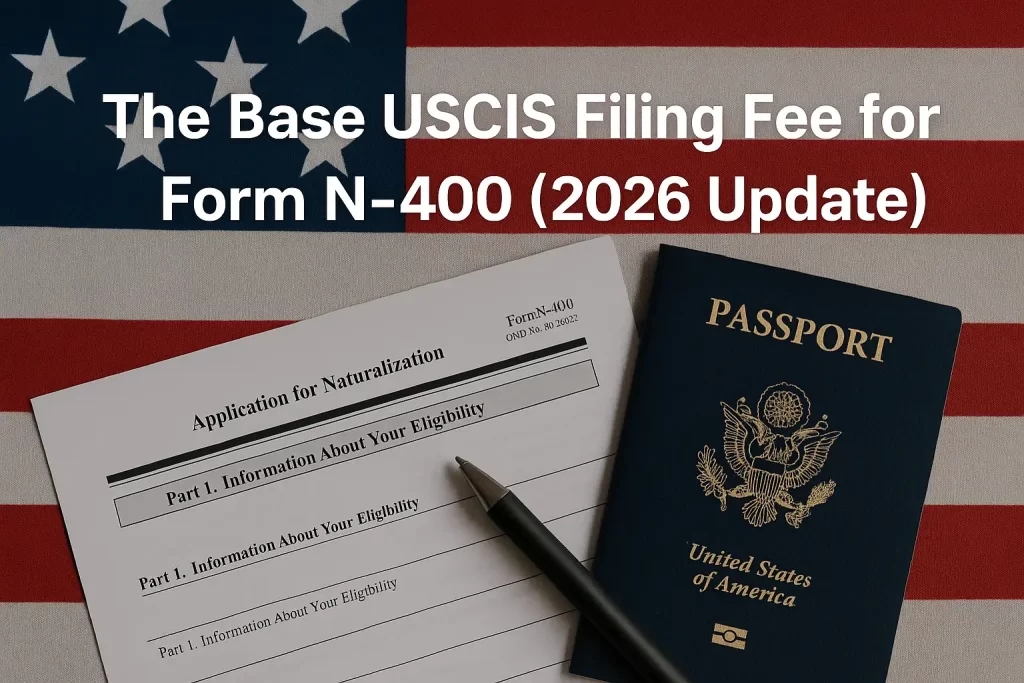
The Form N-400, or Application for Naturalization, is the primary form used to apply for U.S. citizenship. As of 2026, the USCIS filing fee remains the largest part of the total cost — and it has seen steady adjustments over recent years to reflect administrative processing expenses.
Current Estimated Fee for 2026
According to the latest USCIS fee schedule updates, the base filing fee for Form N-400 in 2026 is expected to be around $760 for paper filing and $710 for online filing. This reflects a modest increase from the 2025 rate (approximately $725 for both versions). The higher paper-based fee encourages applicants to use USCIS’s digital system, which streamlines document submission and processing times.
What This Fee Covers
The filing fee supports the review of your naturalization application, including:
- Verification of your permanent resident status
- Background and security checks
- Review of your biometrics (if required)
- Processing of your citizenship test and interview results
It’s important to note that USCIS fees are non-refundable, even if your application is denied. That’s why preparing thoroughly — and submitting a complete, accurate N-400 form — is essential before paying.
Fee Waivers and Reductions
If the filing cost seems high, you may qualify for a fee waiver (Form I-912) or a reduced fee (Form I-942).
- Fee waivers are available to applicants receiving certain public benefits or with household income at or below 150% of the federal poverty level.
- Reduced fees are available for those earning between 150% and 200% of the poverty level.
If approved, the reduced N-400 fee for 2026 may be around $380, while full fee waivers cover the entire amount.
Pro Tip
Always verify the current fee on the official USCIS Fee Schedule page before filing, as adjustments can take effect midyear. To avoid delays, include the correct fee amount and double-check your payment method before submitting your application.
In the next section, we’ll cover another important part of your citizenship cost — the biometric services fee, and when you’ll need to pay it.
🧾 Biometric Services Fee — What You’ll Pay and When It’s Required
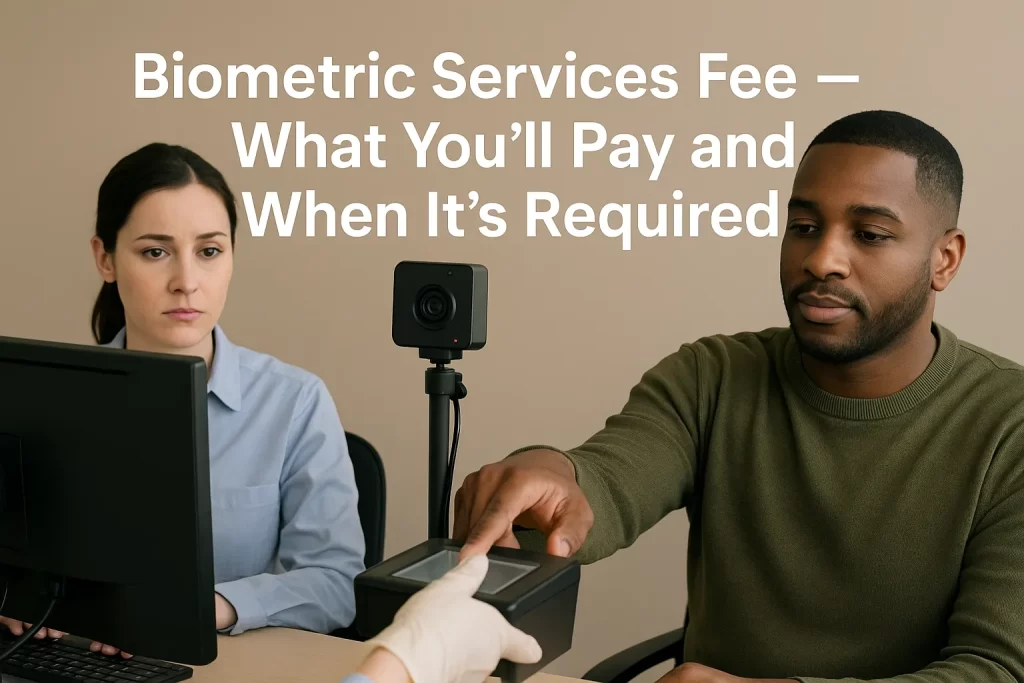
In addition to the Form N-400 filing fee, most applicants must also pay a biometric services fee, which covers the cost of identity verification and background checks through fingerprinting, photographs, and digital signatures.
Standard Biometric Fee in 2026
As of 2026, the biometric services fee remains $85 for most applicants, although USCIS may adjust this rate slightly based on its new fee rule and administrative cost updates. This fee is typically required for applicants between the ages of 14 and 79, and it is paid at the same time as the Form N-400 filing fee.
When you pay online through your USCIS account, the total amount (filing + biometrics) is combined into one transaction — making it easier to track and confirm payment.
When You Might Not Have to Pay the Biometric Fee
Certain applicants may be exempt from paying the biometric fee, including:
- Applicants over 79 years old (biometrics not required)
- Applicants filing for naturalization based on military service
- Those granted a fee waiver or reduction through Form I-912 or Form I-942
If you qualify for a full or partial fee waiver, USCIS will automatically remove or reduce the biometric charge when processing your application.
What Happens After Payment
Once USCIS receives your payment and application, they will schedule your biometrics appointment — typically within 3–8 weeks. You’ll receive an official appointment notice (Form I-797C) with the date, time, and location.
At the appointment, USCIS will collect your fingerprints, take your photo, and verify your identity. This step is essential for conducting FBI background checks before you move on to the interview and civics test stage.
Pro Tip
Bring your appointment notice and a valid photo ID (such as a Green Card or passport) to your biometrics appointment. If you need to reschedule, contact USCIS before your appointment date to avoid delays — missing it could postpone your entire citizenship process.
In the next section, we’ll explore optional costs you might need to plan for — including attorney fees, document preparation, and study materials.
📄 Optional Costs — Legal Help, Document Preparation, and Test Materials

Beyond the mandatory filing and biometric fees, applicants should plan for optional costs that can make the citizenship process smoother and more efficient. These aren’t required by USCIS, but they’re often part of preparing a strong and complete naturalization application.
1. Legal and Consultation Fees
Many applicants choose to work with an immigration attorney or accredited representative to ensure accuracy, address eligibility concerns, or get support for complex cases.
- The average attorney fee for Form N-400 preparation ranges from $500 to $1,500, depending on case complexity.
- For simple consultations or application review services, you may pay between $100 and $300.
Hiring an experienced immigration lawyer can help prevent costly errors or delays — especially for applicants with prior immigration issues, travel histories, or criminal records.
2. Document Preparation and Translations
You might need to provide certified translations for documents such as birth certificates, marriage certificates, or court records.
- Certified translations typically cost $20–$50 per page.
- Passport photos, printing, or notary services may add another $20–$40.
Keep all receipts and copies of these services, as you may need to present them later during your interview.
3. Citizenship Test Study Materials and Classes
While USCIS offers free study guides and practice tests, some applicants prefer to take citizenship preparation classes to build confidence.
- Online and community-based courses can range from $50 to $300, depending on location and duration.
- Private tutoring or ESL (English as a Second Language) support can cost more but may be helpful for those struggling with English proficiency.
4. Additional Services or Submissions
If you’re applying from abroad or need to replace a lost Green Card before applying, you might face added costs:
- Form I-90 (Green Card replacement) costs around $540 in 2026.
- Mailing or courier fees for international applicants vary by location.
Pro Tip
You don’t have to spend a fortune to prepare well. Many local libraries, nonprofit organizations, and adult education centers offer free or low-cost resources for the civics and English tests. Always explore community programs before paying for private classes.
Next, we’ll look at fee waivers and reductions — a key way to lower your total cost if you meet income or eligibility requirements in 2026.
🌍 Fee Waivers and Reductions — Who Qualifies in 2026?
For many applicants, the cost of applying for U.S. citizenship can feel overwhelming. Thankfully, USCIS offers fee waivers and reductions to make the process more accessible for low-income individuals and families. In 2026, these programs continue to play a vital role in ensuring that financial hardship doesn’t stop eligible residents from becoming citizens.
1. Full Fee Waiver (Form I-912)
If you’re unable to afford the Form N-400 filing fee and biometric fee, you may qualify for a full waiver using Form I-912 (Request for Fee Waiver).
You can apply for a fee waiver if:
- You receive means-tested public benefits, such as SNAP, Medicaid, or SSI.
- Your household income is at or below 150% of the Federal Poverty Guidelines.
- You can show financial hardship, such as medical expenses or unemployment.
When approved, your entire USCIS fee is waived — meaning you can apply for citizenship at no cost.
2. Reduced Fee Option (Form I-942)
If your income is slightly above the fee waiver limit, you may still qualify for a reduced filing fee. Using Form I-942 (Request for Reduced Fee), USCIS allows eligible applicants with household incomes between 150% and 200% of the Federal Poverty Guidelines to pay a discounted N-400 fee (around $380 in 2026).
This option makes the citizenship process more affordable while maintaining accountability for applicants who can contribute part of the cost.
3. Automatic Waivers
Certain groups are automatically exempt from paying naturalization fees, including:
- U.S. military service members and veterans applying under INA Section 328 or 329.
- Applicants filing for naturalization based on military family benefits.
- Applicants over 79 years old, who are not required to complete biometrics.
4. How to Apply for a Fee Waiver or Reduction
- Complete and attach the correct form (I-912 or I-942) along with your N-400 application.
- Include proof of income, such as pay stubs, W-2 forms, or benefit award letters.
- If applying online, you’ll be guided through a digital questionnaire to determine eligibility before submission.
💡 Pro Tip: USCIS will deny applications missing financial evidence or incomplete forms. Always review the latest Form I-912 and I-942 instructions on the USCIS website before filing.
Next, we’ll go over how to pay your USCIS fees in 2026, including accepted payment methods and tips to avoid common mistakes.
💳 How to Pay USCIS Citizenship Fees in 2026

Once you know the total amount you’ll need to pay, the next step is understanding how to make your payment correctly. USCIS accepts several payment methods in 2026, and choosing the right one can help you avoid delays or rejections.
1. Paying Online Through Your USCIS Account
The easiest and most secure method is to pay through your USCIS online account at my.uscis.gov.
- You can pay using a debit card, credit card, or U.S. bank account (ACH transfer).
- When paying online, the total amount — including your N-400 filing fee and biometric fee — is combined into a single transaction.
- You’ll immediately receive an electronic receipt notice and payment confirmation, which you can download for your records.
💡 Tip: Always print or save your online payment confirmation. It acts as proof of submission if there’s ever a delay in processing.
2. Paying by Mail (Paper Applications)
If you’re filing a paper application, you can pay using one of the following:
- Check or money order made payable to “U.S. Department of Homeland Security” (never abbreviate).
- Credit card payment using Form G-1450 (Authorization for Credit Card Transactions) — attach it on top of your N-400 package.
Always include the correct total and double-check your payment type. If your payment fails or the check bounces, USCIS will reject your application.
3. Payment for Fee Waiver or Reduction Requests
If you submitted a fee waiver (Form I-912) or reduced fee request (Form I-942), do not include payment unless USCIS denies your request. Once approved, the system will automatically apply the adjusted amount.
4. Common Mistakes to Avoid
- Using outdated fee amounts from old USCIS forms.
- Forgetting to sign your check or money order.
- Paying separately for biometrics instead of including it in the total.
- Submitting foreign checks or cash (USCIS does not accept cash).
5. Payment Tracking and Verification
After payment, USCIS will issue a receipt number starting with three letters (such as IOE or LIN). You can use this number to track your case online and verify that your payment was processed successfully.
If a payment issue arises, USCIS will send a notice explaining the problem and how to correct it.
In the next section, we’ll review other related expenses — small but important costs that many applicants overlook when budgeting for citizenship.
⚖️ Other Related Expenses to Consider
Even after you’ve paid your USCIS filing and biometric fees, there are a few additional expenses to keep in mind when budgeting for your citizenship application. These costs aren’t officially part of the application fee, but they can affect your total out-of-pocket spending as you move through the process.
1. Travel and Transportation Costs
Depending on where you live, your biometrics appointment, interview, or naturalization ceremony may take place at a USCIS field office in another city.
- Local transportation or intercity travel can add up, especially if you need to attend multiple appointments.
- If you live in a rural area, plan for fuel or public transit expenses and possible time off work.
2. Mailing and Document Costs
If you’re filing by mail, you may need to send your documents using certified or priority mail to track delivery and ensure USCIS receives everything safely.
- Expect to spend $10–$25 on postage, depending on your location and mailing method.
- Some applicants also choose to make photocopies of every document for their records — a small but wise expense.
3. Replacement or Supplemental Documents
If your Green Card is expired, lost, or damaged, you must replace it before applying for citizenship.
- The Form I-90 (Application to Replace Permanent Resident Card) costs around $540 in 2026.
- You might also need to request certified copies of birth certificates or court documents, which can cost $15–$50 each.
4. Naturalization Ceremony Costs
While the ceremony itself is free, there may be small optional costs, such as:
- Passport application fees (about $165 for adults in 2026)
- Professional photos for your naturalization certificate
- Travel or attire for the ceremony
5. Financial Cushion for Unexpected Delays
Citizenship processing can take several months. It’s smart to keep a small financial buffer for rescheduled appointments, updated photos, or reissued documents. A reserve of $100–$200 is often enough for these incidental expenses.
💡 Pro Tip: Plan your citizenship budget as if you’re preparing for a major life event — because you are. By setting aside funds early, you’ll ensure that no step in your naturalization journey catches you off guard.
Next, we’ll cover what to expect after paying your fees — including the processing timeline and USCIS’s refund policies.
📆 What to Expect After Paying the Fees — Timeline and Refund Policy
Once you’ve submitted your Form N-400 and paid the required fees, the naturalization process officially begins. Understanding what happens next — and what to expect from USCIS — can help you stay organized and avoid unnecessary worry.
1. Receipt Notice (Form I-797C)
After your payment is processed, USCIS will send a Receipt Notice (Form I-797C) confirming that your application has been received.
- For online filings, this notice appears instantly in your USCIS account.
- For paper applications, it typically arrives within 2–4 weeks by mail.
This notice contains your receipt number, which you can use to track your case status on the USCIS website.
2. Biometrics Appointment
Within 3–8 weeks, you’ll receive a biometrics appointment notice. This step is required for most applicants and involves fingerprinting, photographing, and background checks.
If you’ve already submitted biometrics for another application recently, USCIS may reuse them, saving you time.
3. Interview and Civics Test Scheduling
After biometrics, you’ll wait several months for your citizenship interview and civics test appointment.
In 2026, the average processing time for naturalization applications ranges from 8 to 12 months, depending on your local USCIS field office.
During this interview, an officer will review your N-400, test your English and civics knowledge, and confirm your eligibility for citizenship.
4. Decision and Oath Ceremony
If your application is approved, USCIS will schedule you for the Oath of Allegiance ceremony, often within 1–3 months after your interview.
Once you take the oath, you officially become a U.S. citizen — and you can apply for your U.S. passport immediately after.
5. Refund Policy
USCIS fees are non-refundable, regardless of the outcome of your application. This means that even if your application is denied, withdrawn, or closed, you won’t receive your payment back.
However, if your application is rejected before processing (for example, due to incorrect payment amount or unsigned forms), USCIS will typically return your entire package and unprocessed payment.
💡 Pro Tip: Double-check your eligibility, fee amount, and documentation before submitting your N-400. A few minutes of review can save months of waiting — and hundreds of dollars in nonrefundable fees.
Next, we’ll conclude with a summary of everything you need to know to plan and budget effectively for your U.S. citizenship application in 2026.
✅ Conclusion: Planning Your U.S. Citizenship Budget for 2026
Applying for U.S. citizenship is more than just a legal step — it’s an investment in your future. Understanding the full cost upfront helps you plan wisely, avoid delays, and ensure that your journey to becoming an American citizen goes as smoothly as possible.
In 2026, expect the Form N-400 filing fee to remain the largest expense, with additional costs for biometrics, legal assistance, translations, and documentation depending on your situation. Thankfully, fee waivers and reduced payments remain available to make naturalization accessible for all qualified residents.
Before submitting your application, always check the latest USCIS fee schedule, confirm your eligibility, and gather all required evidence. A few hours of preparation now can save you time, stress, and unnecessary expenses later.
Becoming a U.S. citizen is a milestone worth every effort — and knowing how to manage the financial side of the process ensures that nothing stands between you and your oath of allegiance. 🇺🇸
Further Links
💼 Read the full guide on our Immigration Blog:
https://www.usavisalaw.com/immigration-blog
📄 USCIS – Form N-400 (Application for Naturalization):
https://www.uscis.gov/n-400
📄 USCIS – Form I-912 (Request for Fee Waiver):
https://www.uscis.gov/i-912
📄 USCIS – Form I-942 (Request for Reduced Fee):
https://www.uscis.gov/i-942
💳 Learn more about paying USCIS fees online:
https://www.uscis.gov/uscis-fee-payment
📘 Related Reading:
- USCIS Fee Changes 2025: What You Need to Know
- Understanding the I-130 Petition for Family Sponsorship
- Work Permits in the U.S.: How to Qualify and Apply
💬 Need help applying for U.S. citizenship or a fee waiver?
Contact American Visa Law Group for expert legal support:
https://www.usavisalaw.com/contact