


Applying for U.S. citizenship through Form N-400 is one of the most exciting milestones in your immigration journey — but it can also be one of the most stressful. Every year, thousands of applicants are denied, often for reasons that could have been avoided with the right preparation. From missing documents to small errors on the application, even minor mistakes can cost you time, money, and peace of mind.
The truth is, USCIS looks closely at every detail of your N-400. They check your continuous residence, physical presence, taxes, criminal history, and even how you perform in your interview and tests. If something doesn’t add up, your application could be delayed — or denied altogether.
The good news? Understanding the most common reasons for N-400 denials gives you a huge advantage. In this guide, you’ll learn the top mistakes to avoid, how to spot potential red flags in your own case, and what you can do to improve your chances of success.
📄 Missing or Incorrect Documentation
One of the most common — and preventable — reasons for N-400 denial is missing or incorrect documentation. USCIS won’t move forward with your case if your file is incomplete or inconsistent, and in many situations, applicants don’t even realize they’ve made a mistake until it’s too late.
For example, some people forget to include copies of their green card (front and back), or they send an expired card without realizing it’s a problem. Others might submit old passports with mismatched dates, or forget to attach proof of marriage or divorce when their application is based on a marital relationship. USCIS reviews all of these documents closely, and if something looks off, your application can be flagged.
Another common issue is inconsistent information. Maybe you listed your address history differently on your N-400 compared to your earlier immigration forms, or perhaps you forgot about a short trip outside the U.S. that doesn’t appear in your travel history. These details may feel small, but to USCIS, they raise questions about accuracy and credibility.
💡 Pro tip: Create a checklist before you submit your application. Double-check that you’ve included:
- A valid copy of your permanent resident card
- Updated identification documents (passport, driver’s license)
- Proof of any name changes (marriage certificate, divorce decree, or court order)
- Accurate records of your residence, work history, and travel dates
If you aren’t sure about a document, it’s always better to submit too much rather than too little. Missing paperwork slows down your case, and in the worst case, it results in outright denial.
💼 Employment & Tax Issues
Another major reason N-400 applications get denied is related to taxes and employment history. USCIS wants to see that you’ve been a responsible resident who follows U.S. laws, and your financial record plays a big role in proving that.
One of the most common problems is not filing federal or state tax returns. Even if your income was low, you’re usually still required to file a return. When USCIS sees gaps in your tax history, it raises questions about your eligibility and your willingness to comply with U.S. obligations.
Tax debts are another big red flag. If you owe the IRS and haven’t set up a payment plan, USCIS can deny your application for failing to demonstrate “good moral character.” The good news? If you’re already on an approved installment plan and making regular payments, that usually won’t block your application.
Employment issues can also cause problems. For instance, if you worked without authorization before getting your green card, USCIS may question your history. While this doesn’t always result in denial (especially if it happened long before your residency), it’s still something they can consider.
💡 Pro tip:
- Make sure all your tax returns are filed and up-to-date before applying.
- If you owe back taxes, set up a payment plan with the IRS and keep proof of your agreement.
- Gather W-2s, 1099s, or pay stubs that confirm your employment history if USCIS asks for it.
- Be upfront about any past unauthorized employment — hiding it is riskier than being honest.
At the end of the day, USCIS wants to see that you’re financially responsible and committed to following the rules. Cleaning up any tax or employment issues before filing can save you months of stress and prevent a denial that could have been avoided.
⚖️ Criminal History & Moral Character Concerns
When USCIS reviews your N-400 application, one of the biggest factors they look at is your moral character. Even if you’ve been a permanent resident for years, certain criminal records or questionable behavior can lead to a denial.
The law requires applicants to show “good moral character” during the statutory period (usually five years before applying, or three years if applying through marriage). But here’s the catch: USCIS can also consider behavior outside that period if it’s serious enough.
Some of the most common issues include:
- DUIs and drug-related offenses — even a single incident can raise red flags.
- Domestic violence or assault charges — USCIS treats these very seriously.
- Theft, fraud, or dishonesty-related crimes — they suggest a lack of integrity.
- False testimony or lying to USCIS — even something small, like hiding an arrest, can lead to denial.
Sometimes, applicants think a dismissed case or an old misdemeanor won’t matter, but USCIS still sees the record. They don’t just look at convictions; they examine arrests, charges, and your overall honesty about them.
💡 Pro tip:
- Always disclose your entire criminal history, even if charges were dropped.
- Gather court records and proof of completion for any probation, classes, or fines.
- If you’ve had a DUI or another serious case, consider speaking with an immigration attorney before applying.
- Don’t assume USCIS won’t find out — background checks are thorough.
Good moral character isn’t just about avoiding crime. Things like failing to pay child support, not filing taxes, or giving false information on past applications can also be used against you. The safest path is to be upfront, take responsibility, and show evidence of rehabilitation if needed.
💔 Marriage & Family-Based Red Flags
If your N-400 application is based on marriage to a U.S. citizen, USCIS will look very closely at your relationship. Unfortunately, many denials happen because applicants can’t provide enough proof that their marriage is real and ongoing.
One of the most common red flags is inconsistent answers between spouses during the interview. Officers often ask simple questions — like where you first met, what side of the bed you sleep on, or who cooks at home. If your answers don’t match, it can raise suspicion.
Another issue is recent or unstable marriages. If you filed soon after getting married, or if you and your spouse are separated or going through divorce, USCIS may question whether the relationship is genuine. Even if your marriage was real, a pending divorce during the process can complicate eligibility.
Fraud is a major concern as well. USCIS is trained to spot signs of a sham marriage — such as lacking shared finances, no evidence of cohabitation, or only meeting your spouse a few times before marrying. Any hint of dishonesty can not only lead to a denial but also trigger removal proceedings.
💡 Pro tip:
- Bring strong evidence: joint leases, tax returns, utility bills, photos, and affidavits from friends/family.
- Be prepared to answer personal but simple questions consistently with your spouse.
- If you’re divorced or separated, consult an attorney before applying to understand how it affects your eligibility.
- Never attempt to “fake it” — marriage fraud can have lifelong immigration consequences.
When it comes to family-based applications, honesty and solid proof are your best allies. The stronger your documentation, the easier it is to show USCIS that your marriage is real and deserving of approval.
🗣️ English & Civics Test Failures
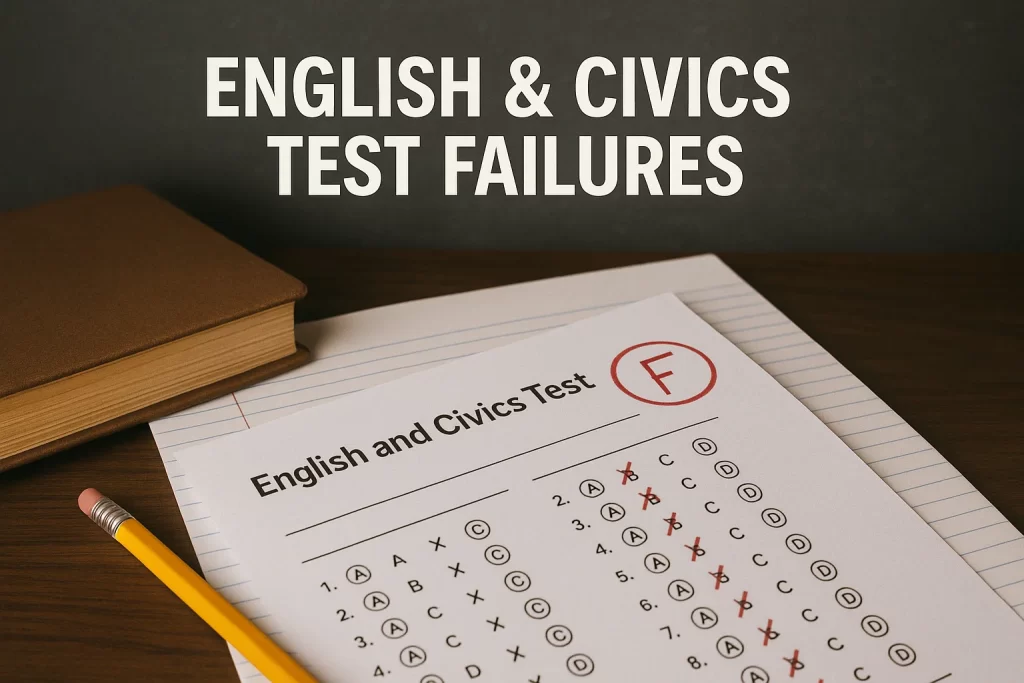
Every N-400 applicant must pass the English and civics tests, unless they qualify for an exemption. Failing one or both of these tests is a surprisingly common reason for denial.
The English test includes reading, writing, and speaking. Many applicants underestimate this part, thinking everyday conversation skills are enough. But the test is structured and requires you to demonstrate clear understanding. Even nervousness during the interview can affect your performance.
The civics test is another challenge. You’ll need to answer questions about U.S. history, government, and rights of citizens. USCIS officers may ask up to 20 questions, and you must answer at least 12 correctly to pass. Many applicants fail simply because they didn’t study enough or didn’t use the official USCIS study materials.
You do get two chances to pass: once during your initial interview and again if USCIS schedules a re-test. However, if you fail both times, your N-400 will be denied.
💡 Pro tip:
- Use the official USCIS study guides and apps to prepare.
- Practice reading and writing in English daily — even short sentences help build confidence.
- If eligible, apply for an exemption (for example, applicants over a certain age with long-term permanent residency).
- Don’t wait until the last minute; consistent practice makes the test far less stressful.
Failing these tests doesn’t mean you’ll never become a U.S. citizen — you can usually reapply later. But it does cost you time, money, and energy. Preparing thoroughly the first time is the smartest path forward.
🧾 Incomplete or Incorrect N-400 Form

It may sound simple, but one of the biggest reasons USCIS denies N-400 applications is because the form itself was filled out incorrectly or left incomplete. The N-400 is long and detailed, and even a small mistake can raise questions about your eligibility or credibility.
A common issue is leaving entire sections blank. For example, forgetting to list every address you’ve lived at in the last five years, skipping details about your employment history, or not including all your trips outside the U.S. USCIS expects complete answers — missing information can make it look like you’re hiding something.
Another problem is inconsistent details. If your travel history, work dates, or even your name doesn’t match what you’ve stated in previous immigration forms, officers will notice. These inconsistencies may not be intentional, but they can still lead to delays, requests for more evidence, or outright denial.
Some applicants also make the mistake of using an outdated version of the N-400 form or not signing it correctly. USCIS is strict about following instructions to the letter, so small errors like these can cost you dearly.
💡 Pro tip:
- Download the most recent version of the N-400 directly from USCIS before filing.
- Double-check every section, even if you think it doesn’t apply. If something truly doesn’t apply, write “N/A” instead of leaving it blank.
- Compare your answers to previous applications (like your green card forms) to make sure everything matches.
- Always sign and date your application — missing a signature is an automatic rejection.
Taking extra time to carefully review your N-400 before submission can save you months of waiting and the heartbreak of denial for something that could have been avoided.
⏱️ Missed Appointments or Deadlines
Another surprisingly common reason for N-400 denials is something as simple as missing appointments or deadlines. USCIS runs on strict timelines, and if you don’t show up or respond when required, your case can be closed or denied automatically.
One major issue is skipping your biometrics appointment. This step is essential for background checks, and rescheduling too many times can make USCIS think you’re not taking the process seriously. If you don’t attend, your application won’t move forward.
Another problem is missing the naturalization interview. Life happens — emergencies, illness, or work conflicts — but unless you provide valid proof and reschedule properly, USCIS will deny your application for failure to appear.
Finally, failing to respond to Requests for Evidence (RFEs) or notices within the deadline is another deal-breaker. USCIS gives you a strict timeframe to submit extra documents or explanations, and if you miss it, your case is often denied without further review.
💡 Pro tip:
- Mark all USCIS appointments on your calendar as soon as you get them.
- If you can’t attend, request a reschedule immediately and provide a legitimate reason.
- Open every USCIS notice right away and track deadlines carefully.
- Keep your address updated with USCIS so you don’t miss important mail.
Missing just one step can undo months of waiting and preparation. Treat every deadline as non-negotiable — because to USCIS, it is.
🧩 Other USCIS Red Flags
Even if you meet all the basic requirements, USCIS officers are trained to watch for red flags that could indicate fraud, dishonesty, or ineligibility. These issues might not be obvious at first, but they can absolutely result in a denial.
One big red flag is submitting fraudulent or altered documents. Even if the mistake wasn’t intentional — say, you relied on a poorly translated certificate — USCIS can treat it as fraud. Once flagged, it can affect not only your N-400 but also your ability to apply for any future immigration benefits.
Another common issue is having an outstanding deportation or removal order. If you’re in removal proceedings, USCIS may not approve your application unless those proceedings are resolved. Similarly, if you’ve had an order in the past, you’ll need to provide documentation proving your current eligibility.
Security concerns are also on the list. If USCIS finds evidence linking you to certain groups, organizations, or activities that raise national security questions, your application could be denied immediately.
💡 Pro tip:
- Never submit false, incomplete, or altered documents — honesty is always the safer path.
- If you’ve had any immigration court cases, gather all records and consult a lawyer before filing.
- Be prepared to explain any affiliations, memberships, or travel history that could seem suspicious.
- Keep your application consistent with past filings — sudden changes in your story will raise questions.
At the end of the day, USCIS is looking for trustworthiness. If anything in your application suggests dishonesty, fraud, or unresolved immigration issues, it could derail your path to citizenship. The best defense is to be transparent, consistent, and well-prepared.
✅ Conclusion
Becoming a U.S. citizen is one of the most meaningful milestones in your immigration journey, but the truth is that N-400 denials are more common than many people realize. The good news? Most of these denials happen for reasons you can control — missing documents, gaps in residency, unpaid taxes, criminal issues, test failures, or skipped appointments.
By understanding the most common reasons N-400 applications get denied, you can prepare better and avoid mistakes that cost you time, money, and peace of mind. Double-check your paperwork, stay on top of deadlines, study for the tests, and be completely honest with USCIS. If you know you have a red flag in your case — like a past conviction or long trips abroad — deal with it early rather than hoping it slips through unnoticed.
At the end of the day, success comes down to preparation and honesty. When in doubt, consulting with an experienced immigration attorney can give you the confidence and guidance you need. Don’t let preventable errors stand in the way of your dream. With the right steps, your path to U.S. citizenship can be smooth, clear, and achievable.
📚 Further Reading & Resources
- USCIS Form N-400, Application for Naturalization (Official Page)
- Continuous Residence and Physical Presence Requirements for Naturalization
- USCIS Naturalization Test Study Resources
- Good Moral Character for Naturalization
- How to Appeal a Denied N-400 (Form N-336)
- American Immigration Lawyers Association (AILA)