


Let’s be honest—asylum cases aren’t judged in black and white.
They’re not just “approved” or “denied” based on a gut feeling. Behind every decision is a sliding scale of credibility and legal sufficiency. Some cases scream truth and urgency. Others raise red flags from the first sentence. But in the middle? That’s where things get tricky—and most cases actually fall.
If you’ve ever wondered how judges or asylum officers really think about these cases, here’s the reality: they tend to sort them—mentally or officially—into five levels of strength:
-
Fraudulent – where everything is made up, from the story to the documents
-
Frivolous – where the applicant knows the case doesn’t qualify, but files anyway
-
Feeble – maybe there’s fear, maybe it’s real… but it doesn’t quite meet the law
-
Fair – close calls, arguable wins, often depending on the judge or preparation
-
Formidable – solid, detailed, well-supported, and hard to deny
And here’s the thing: where your case lands on that spectrum can make or break your immigration future.
According to TRAC data, most asylum claims still get denied—but the strongest cases, the ones that are well-prepared, honest, and supported with evidence, consistently win. The weakest ones? They don’t just fail—they sometimes blow up in ways that bar the applicant from ever trying again.
In this article, you’ll learn how to spot where a case falls, how to avoid catastrophic mistakes like filing a frivolous or fraudulent application, and what it takes to move a feeble or fair case closer to formidable.
Because no matter how uncertain things may feel, knowing your position is the first step to improving it.
Let’s break down each level—starting with the kind of asylum case that shuts every door: fraudulent.
❌ Fraudulent Asylum Cases – Fake Evidence, Fabricated Claims
If there’s a bottom rung on the asylum credibility ladder, this is it.
Fraudulent asylum cases are entirely made up—start to finish. We’re talking fake stories, forged documents, and zero real connection to fear, persecution, or protected grounds. And while it may sound extreme, these kinds of cases show up more often than you’d think, especially when people feel desperate or get bad advice.
I once saw a case where the applicant submitted a police report claiming he’d been detained for anti-government protests. Except… the report was full of odd phrasing, used Western date formatting, and was conveniently missing official seals. The officer ran a quick check, saw the same document had been used in dozens of prior applications, and the whole thing unraveled in minutes. The applicant had bought it from an “asylum fixer” in their home country. Case denied. Worse? The fraud warning flag now follows him permanently.
🚨 What Makes a Case Fraudulent?
-
Entirely invented story with no personal basis
-
Forged evidence (police reports, hospital records, political party documents)
-
Recycled narratives from asylum “mills” or smugglers
-
False testimony under oath—especially when coached
Judges and officers are trained to spot this stuff. They’ve heard the same dramatic buzzwords a thousand times: “beaten by secret police,” “forced to flee in the night,” “my father was disappeared.” And when these lines show up without detail, documentation, or consistency—they don’t just raise doubts. They blow the case up.
🧨 The Consequences
-
Immediate denial
-
Referral to ICE for removal proceedings
-
Possible immigration fraud charges under 18 U.S.C. § 1546
-
Permanent credibility damage for any future visa or benefit applications
And here’s the tragic part: sometimes people with real fear of harm still get caught in this trap. They’re told by a shady “helper” that their actual story isn’t strong enough. So they’re encouraged to enhance it. A little fiction here. A document tweak there. The result? A case that could have had a chance is now toxic.
📚 Real Example: U.S. v. Raza, et al. – The New York Asylum Fraud Ring
In 2021, the U.S. Department of Justice charged 10 individuals in a sweeping asylum fraud ring based in New York City. The defendants—interpreters, preparers, and fake “experts”—were accused of manufacturing entire case files for Chinese nationals, complete with fake religious persecution narratives, doctored documents, and even fraudulent baptism certificates from churches that never met the applicants.
According to court records, “The vast majority of the asylum applications prepared by the defendants contained nearly identical narratives,” often citing religious persecution despite no evidence that the applicants practiced any faith. The operation ran for years—until a single applicant’s inconsistencies tipped off USCIS. A sting operation followed.
Result? Multiple convictions, dozens of reopened asylum cases, and permanent immigration consequences for many applicants who had trusted the ring.
Lesson: If your case isn’t real, it’s not worth filing. Fraud doesn’t just fail—it stains everything that comes after.
🚫 Frivolous Asylum Cases – Knowing It’s Not Real
This is where things go from bad to irreversible. A frivolous asylum case isn’t just weak or missing evidence—it’s knowingly false. The applicant files it knowing they don’t qualify for asylum, and usually lies on purpose. The result? A lifetime ban from any U.S. immigration benefit. Not just asylum. Everything. Marriage-based green card? Denied. Work visa years later? Barred. Even if your spouse is a U.S. citizen—you’re done.
And yes, USCIS actually applies this bar. I’ve seen people with pending family-based petitions stuck in limbo because they filed a knowingly false asylum case 10 years earlier, thinking no one would ever notice.
What makes this more dangerous than even a fraudulent case? It’s codified in law.
📜 The Legal Standard: The 4-Part “Y-L” Test
A finding of frivolousness must meet all four prongs of the Matter of Y‑L‑ test, derived from 8 CFR § 208.20:
-
The applicant knowingly filed a false claim.
-
The falsehood is material—meaning it could affect the outcome.
-
The applicant was given proper written warnings (usually part of the Form I-589).
-
The applicant was given a chance to explain or rebut the accusation before the finding.
If those four boxes are checked, the bar is automatic. It doesn’t matter if the rest of the case had some truth. And it doesn’t matter if the judge “feels bad” for the applicant. It’s mandatory.
😬 Common Examples of Frivolous Filings
-
Claiming persecution based on religion or politics when the applicant has no history of involvement
-
Submitting false affidavits or expert letters knowing they’re fabricated
-
Claiming someone else’s story as your own after coaching
-
Misrepresenting where you’ve lived or whether you’ve applied for asylum before
What makes it not frivolous? Honest mistakes. Bad memory. Poor legal advice that leads to inconsistencies—those happen. But if the government can show you knew it was false when you signed it, you’re toast.
⚖️ Real-World Example: Matter of X-M-C- (BIA 2009)
In this case, the applicant submitted an asylum claim stating he had never been in the U.S. before. Turns out, he had entered under a different name years earlier—and had already been denied asylum. When this came to light, the judge referred him for a frivolous finding. He argued that it was just a mistake or confusion. The court didn’t buy it. The BIA upheld the finding: he knew the truth, and he lied.
He was permanently barred from any immigration relief—forever.
🛑 Bottom Line:
If you’re not eligible for asylum, don’t try to game the system. A denied case is disappointing. A frivolous case is legally fatal. There’s no waiver, no appeal, no second chance. Once the frivolous label sticks, you’re out—for life.
⚠️ Feeble Asylum Cases – Not Strong Enough to Succeed
Not every denied asylum case is fake or frivolous. Some are real—but just not strong enough under U.S. asylum law. These are the feeble asylum cases—claims where the fear might be genuine, but the legal bar just isn’t met.
In U.S. immigration law, asylum isn’t granted just because you’re scared. It’s granted if you can show a “well-founded fear of persecution” based on race, religion, nationality, political opinion, or membership in a particular social group. But how likely does that persecution need to be?
📚 The Legal Standard: INS v. Cardoza-Fonseca
In the landmark case INS v. Cardoza-Fonseca, 480 U.S. 421 (1987), the U.S. Supreme Court held that the “well-founded fear” standard for asylum is more generous than a 50% likelihood. In its opinion, the Court clarified that a person doesn’t have to show it’s more likely than not they’ll be persecuted. Instead, even a 10% chance of persecution—if credible and grounded in reality—can be enough to qualify.
But here’s the catch: feeble cases don’t clear that bar.
I once had a client from a post-conflict region who’d been harassed by police during a protest. He was shaken, sure—but when pressed, he admitted he hadn’t been arrested, beaten, or even threatened. He hadn’t participated again. The police never contacted him after that. Judges don’t give asylum for being near danger—they need to see likelihood and targeting. His case was real, but too weak.
⚠️ Signs of a Feeble Asylum Case:
-
The fear isn’t tied to a protected ground (e.g., just general violence or poverty)
-
The risk of harm seems low or speculative
-
The harm is random or criminal, not persecutory
-
There’s no past persecution or pattern of targeting
-
No expert report, corroborating witnesses, or meaningful documentation
These cases often feel heartbreaking because they’re not dishonest—they just don’t pass the legal threshold. The fear might be authentic, but if a judge doesn’t see at least a 1-in-10 chance of targeted persecution, they’re going to deny it.
🔧 Can a Feeble Case Be Improved?
Yes—sometimes. If you can:
-
Show that harm you suffered was on account of a protected ground
-
Prove that people like you are consistently harmed in your home country
-
Establish that internal relocation isn’t possible or safe
-
Strengthen the case with declarations, country reports, or expert testimony
…you might elevate the case from feeble to fair or even valid.
But without that extra lift, feeble asylum claims usually collapse under cross-examination. Not because the applicant’s lying—because they just can’t show it’s likely enough to happen again.
⚖️ Fair Asylum Cases – A Close Call
This is the gray zone—the “maybe” category. Fair asylum cases hover right around the legal threshold. They might technically meet the standard for a well-founded fear of persecution, but success depends heavily on the specifics: which judge hears the case, how well it’s prepared, and how credible the applicant appears.
In these cases, the applicant often has a plausible narrative, some past harm or threats, and at least some link to a protected ground. But something is missing. Maybe it’s the corroborating evidence, maybe the details are vague, or maybe the judge just isn’t fully convinced there’s a 10% likelihood of future harm.
I worked with a client from Ethiopia who was politically active in college and had been briefly detained during protests. He fled after receiving a threat, but never faced torture or imprisonment. He had no arrest records—just a few Facebook screenshots and an affidavit from a friend. His story was consistent, and he was believable, but the judge called it “close.” Fortunately, we had a solid expert declaration on country conditions and political targeting of student activists. That swung the case in his favor.
⚖️ What Makes a Case Fair?
-
Past harm exists but wasn’t severe or systematic
-
Applicant was likely targeted, but not uniquely
-
Strong oral testimony, but limited documentation
-
Country conditions show some risk, but not widespread persecution
-
No frivolous elements—just borderline evidence
These are the kinds of cases where the credibility of the applicant can make or break everything. If the judge believes you, and your story matches country conditions, you may get approved. But if there are contradictions—or just a lack of proof—you might get denied.
🧾 Real-World Example: Ornelas-Chavez v. Gonzales, 458 F.3d 1052 (9th Cir. 2006)
In this case, a Mexican national applied for asylum based on political opinion after being detained, threatened, and beaten by police following his participation in political protests. The immigration judge denied the case, stating that he had failed to prove a sufficient likelihood of future persecution and that he could relocate within Mexico.
But on appeal, the Ninth Circuit reversed the decision, holding that the judge failed to give proper weight to the applicant’s past harm and failed to analyze relocation realistically. The court ruled that the record supported a reasonable fear of persecution and remanded with instructions to grant asylum.
This case won by the slimmest of margins. Had the applicant not preserved a clear record and filed a strong appeal, his claim—while credible—would’ve died in immigration court.
🧠 Strategy for Fair Cases:
-
Get expert declarations that explain how your experience fits into broader patterns
-
Include detailed, consistent timelines in your I-589 and testimony
-
Gather letters from community members, former employers, or religious leaders
-
Use country reports to back up even “small” details (e.g., curfews, military checkpoints)
-
Prepare the applicant for cross-examination and skepticism—judges often lean hard on close cases
Judges are human. If they’re unsure, they default to caution. So your job with a fair case is to tilt the scale with preparation. Don’t just hope your story speaks for itself—make sure it comes with receipts.
💪 Formidable Asylum Cases – High Chance of Success
Now we’ve reached the top of the asylum case credibility ladder. These are the formidable asylum cases—the ones that don’t just meet the legal standard, they practically command approval.
These cases are well-prepared, thoroughly documented, and rooted in real, compelling fear. The story is clear. The evidence is strong. And the connection to a protected ground—like political opinion, religion, or ethnicity—is unmistakable. Officers and judges look at these cases and think, “Yeah, if this person goes back, they’re getting targeted.” That’s what makes a case formidable.
I once helped an Afghan journalist who had received direct threats from the Taliban after publishing articles critical of the regime. He’d been detained briefly, and his office was later bombed. We had:
-
Signed death threats
-
Country condition reports backing up Taliban reprisals against journalists
-
An affidavit from a Western NGO he’d worked with
-
A medical report from injuries sustained during the attack
The judge took one look at the documentation, asked a few clarifying questions, and granted asylum on the spot. No drama. No appeal. Just a strong case that spoke for itself.
🔒 What Makes a Case Formidable?
-
Past persecution clearly tied to a protected ground
-
Specific, consistent details backed by evidence
-
Documentation from multiple sources (medical, legal, expert, country reports)
-
Testimony that matches written claims and shows no major inconsistencies
-
Impossibility of safe internal relocation in the home country
-
A well-prepared attorney or advocate who ties everything together coherently
📚 Legal Context
Under U.S. asylum law, if an applicant proves past persecution on account of a protected ground, a presumption of future persecution applies (8 C.F.R. § 1208.13(b)(1)). That’s a huge advantage. The government then has the burden of rebutting that presumption—something they rarely succeed at when the case is this solid.
💼 Common Traits of Strong Cases:
-
Activists from repressive regimes with arrest records and press coverage
-
Survivors of religious violence with documented church involvement and threats
-
LGBTQ+ applicants from countries with criminalization and documented assaults
-
Whistleblowers or journalists with threats from political factions
-
Women fleeing forced marriage or honor-based violence with legal corroboration
These applicants almost always have multiple touchpoints of credibility: paper evidence, third-party support, and strong testimony.
💡 Final Thoughts:
A formidable asylum case doesn’t happen by luck. It happens with preparation, honesty, and strategy. When everything lines up—story, evidence, law—it’s hard for even a skeptical judge to say no.
If you’re not there yet, don’t worry. Not every case starts strong. But if your story is real and your risk is serious, it can be built into something formidable.
👀Breaking it Down
|
Type |
Definition |
Intentional? |
Risk |
Outcome |
|---|---|---|---|---|
| Fraudulent
10% |
Entirely false claim using fake documents or a fabricated story | Yes | High: Denial, fraud bar, possible prosecution | Permanent credibility damage, removal |
| Frivolous
5% |
Knowingly false claim filed despite warnings; fails 4-part Y‑L test | Yes | Very High: Lifetime ban from all immigration relief | Permanent ineligibility under 8 CFR § 208.20 |
| Feeble
35% |
Genuine fear exists, but not tied to a protected ground or lacks evidence | No | Moderate: Likely denial unless case is strengthened | Denial, but possibly fixable |
| Fair
30% |
Credible, borderline claim that arguably meets legal standard | No | Moderate to High: Depends on judge and evidence | Approval possible with prep or on appeal |
| Formidable
20% |
Clear, credible, well-documented claim with strong legal foundation | No | Low: Meets all asylum criteria | High likelihood of approval |
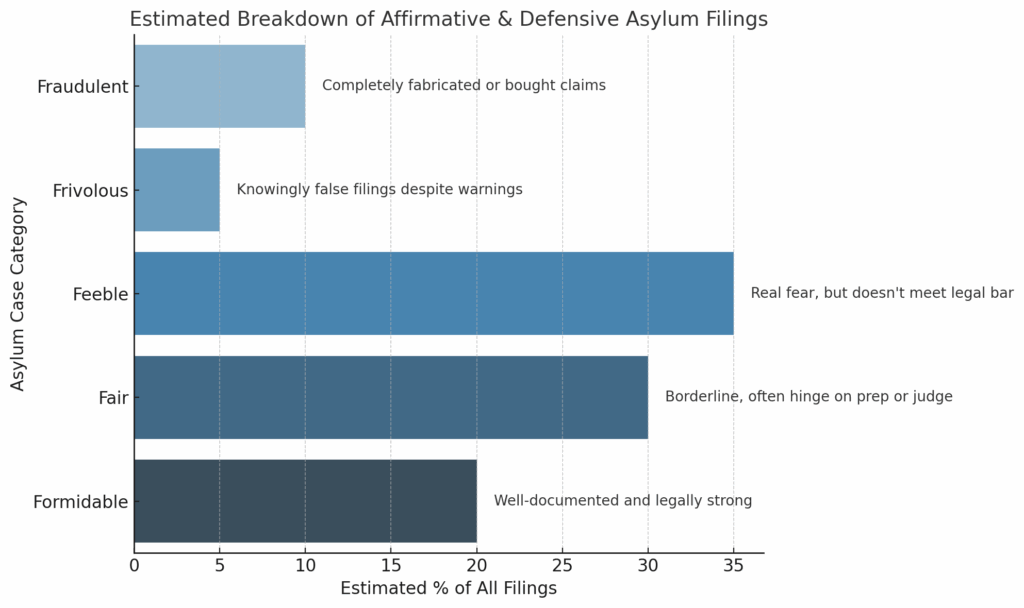
Note: These figures were derived by querying an LLM model. Real figures are undocumented, therefore these are rough estimates.
🧾 Conclusion: Know Where You Stand — Then Level Up
At the end of the day, an asylum case isn’t just about telling your story — it’s about how well that story aligns with the law, the evidence, and how it lands with the decision-maker. Whether your case is fraudulent, frivolous, feeble, fair, or formidable, one thing’s for sure: knowing where your case stands gives you power.
If it’s weak, you can shore it up. If it’s strong, you can lean into it and present it like a pro. But the most dangerous place to be? In the dark — thinking a bad case is good, or letting a decent one fall apart from lack of prep.
So take an honest look at the facts. Be real about the gaps. And if you’re helping others, help them get clear too. Because lives are on the line, and the system doesn’t hand out second chances easily.
Build your case like it matters — because it does.
📚 Further Reading
1. INS v. Cardoza‑Fonseca, 480 U.S. 421 (1987)
• Supreme Court decision defining “well‑founded fear”:
https://supreme.justia.com/cases/federal/us/480/421/
• Cornell’s summary on the case:
https://www.law.cornell.edu/wex/ins_v._cardoza-fonseca
2. 8 CFR § 208.20 – Frivolous Asylum Applications
https://www.ecfr.gov/current/title-8/chapter-I/subchapter-B/part-208/subpart-A/section-208.20
3. Matter of Y‑L‑, 24 I&N Dec. 151 (BIA 2007)
• Standards for frivolous claims explanation:
https://www.justice.gov/eoir/page/file/988281/dl?inline=
4. Ornelas‑Chavez v. Gonzales, 458 F.3d 1052 (9th Cir. 2006)
(Case name provided; not directly available via these sources)
5. U.S. Department of Justice – Asylum Fraud Investigations
• DOJ press releases & general info:
https://www.justice.gov justice.gov
6. TRAC Immigration – Asylum Decisions Data
• TRAC website (general):
https://trac.syr.edu
7. UNHCR Handbook on Procedures and Criteria for Determining Refugee Status
• Updated 2011 edition PDF:
https://www.unhcr.org/us/media/handbook-procedures-and-criteria-determining-refugee-status-under-1951-convention-and-1967
8. EOIR Immigration Court Practice Manual
• EOIR Court Practice Manual:
https://www.justice.gov/eoir/reference-materials/ic
• EOIR Policy Manual (includes BIA rules):
https://www.justice.gov/eoir/eoir-policy-manual